Despite widespread adoption of Multi-Tiered Systems of Support (MTSS) and Comprehensive School Mental Health (CSMH) frameworks, many schools continue to rely disproportionately on Tier 3 clinical interventions, including individual therapy, crisis response, and medication referrals. This overreliance persists due to the present system design to (1) identify the crisis, (2) refer out to a therapist and (3) prescribe medication as needed; even though MTSS is explicitly designed as a prevention-oriented, stepped-care model in which Tier 1 (universal prevention) and Tier 2 (targeted early intervention) reduce the need for intensive services.
This article examines systemic reasons for the underutilization of Tier 1 and Tier 2 supports in school mental health services. It further examines that student misbehaviors, warranting therapeutic referrals must be approached from a trauma-informed lens. Four interacting forces—crisis bias, funding and incentive structures, cultural narratives surrounding therapy, and professional turf dynamics—contribute to a pattern in which clinical services function as the front door rather than the final tier of support. Drawing on MTSS research and implementation science, the authors argue that prevention-first systems are not only more cost-effective but also improve student outcomes, reduce crisis escalation, and preserve clinical capacity. The article concludes with a prevention-first framework, Training and Coaching Model that restores Tier 1 and Tier 2 as foundational components of sustainable school mental health systems.
Schools and school-based clinic services are increasingly positioned as de facto mental health providers for children and adolescents. Rising rates of anxiety, depression, trauma exposure, behavioral dysregulation, and school-based crises have prompted districts nationwide to expand clinical partnerships, add school-based therapists, school-based health clinics, and increase referrals to external mental health services, whenever necessary. Tier 3 interventions—diagnosis, therapy, and psychiatric care—are essential for students with significant and persistent mental health needs.
However, Tier 3 interventions will only address a minority of the mental health needs of student’s identified in school settings. When addressing student behaviors, it is often the unrecognized trauma in students that is often manifested as behavioral challenges—such as aggression, defiance, withdrawal, or hyper-vigilance—as they exist in a constant “fight, flight, or freeze” state. These “big behaviors” are frequently misinterpreted as simple discipline issues, masking underlying emotional distress and unmet needs. (Bures, 2023) Alliance Against Seclusion and Restraint December 2023)
For students who are not displaying these behaviors, a persistent and concerning pattern has emerged: students and staff frequently bypass Tier 1 and Tier 2 supports and move directly into Tier 3 care. This practice contradicts the stepped-care logic central to MTSS and public health prevention models. MTSS was designed to allocate resources efficiently by ensuring that most students receive effective support at the lowest necessary tier, reserving intensive interventions for those who do not respond to earlier supports (Sugai & Horner, 2002).
In a well-functioning system, Tier 1 universal prevention and Tier 2 targeted interventions reduce the proportion of students who require Tier 3 services. When Tier 1 and Tier 2 are weak, fragmented, or inconsistently implemented, clinical services become the default response rather than the safety net. Understanding why this misalignment persists is essential to building sustainable, equitable, and effective school mental health systems.
MTSS and the Evidence for Tier 1 and Tier 2 Effectiveness
The MTSS framework is grounded in decades of prevention science and educational research. Across academic, behavioral, and social-emotional domains, MTSS emphasizes early identification, data-based decision-making, and graduated levels of support (Lane et al., 2007).
Research consistently demonstrates that:
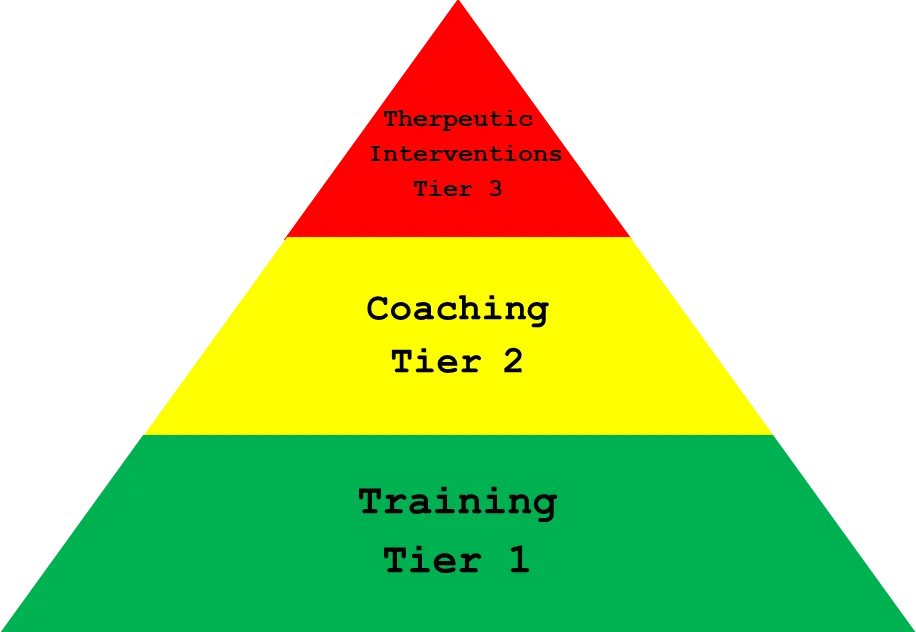
Similarly, the Training and Coaching Model for Behavioral Intervention, see Figure1, intervenes with underlying traumatic events offering Tier 1 and 2 behavioral supports.
Figure 1: The Training and Coaching Model for Behavioral Intervention
Figure 1: The Training and Coaching Model for Behavioral Intervention
The Training and Coaching Model for Behavioral Intervention creates a trauma-informed school culture that supports all students, including those whose trauma is unknown.
Tier 1 strategies within the Training structure would include:
Tier 2 strategies within the Coaching structure—such as targeted coaching, mentoring, and early trauma-response supports—further reduce escalation and improve emotional regulation among at-risk students. Other targeted interventions specifically for students not responding to Tier 1 supports and displaying signs of trauma-related distress would also include a deeper-dive into coaching techniques, but would also integrate components, such as:
In mental health specifically, universal social-emotional learning (SEL), coping skills instruction, trauma-informed practices, and relationship-centered school climates have been shown to reduce anxiety, behavioral incidents, and disciplinary referrals while improving academic engagement (Durlak et al., 2011). Unrecognized trauma in students is addressed using a Multi-Tiered System of Supports (MTSS) that blends trauma-informed care with academic/behavioral interventions.
Tier 1 provides schoolwide, universal supports for all students (e.g., SEL, safe environments), while Tier 2 offers targeted, small-group interventions for those showing early signs of distress. Gee, K., Murdoch, C., Vang, T., Cuahuey, Q., & Prim, J. (2020)
The Training and Coaching Model for Traumatic Intervention also aligns with SEL theory and practice. Despite this evidence, implementation in practice often diverges sharply from the model.
The Crisis Bias: Fear, Urgency, and Liability
One of the most powerful drivers of Tier 1 and Tier 2 underutilization is crisis bias. School administrators and multidisciplinary teams operate under intense pressure, balancing safety, liability, staffing shortages, and public scrutiny. When a student presents with emotional distress or behavioral escalation, the impulse is often to act quickly and decisively by referring to a licensed clinician or emergency service.
From a leadership perspective, this response feels defensible. In crisis situations, the perceived risk of doing “too little” outweighs concerns about doing “too much.” Prevention and early intervention support, while evidence-based, may appear slower, less concrete, or insufficient in the moment. As a result, systems become reactive rather than preventive.
Ironically, this crisis-driven escalation perpetuates the very conditions that produce more crises. When students do not receive coping skills, emotional literacy, and regulation strategies early, stress accumulates and escalates into anxiety, depression, or behavioral outbursts—eventually triggering Tier 3 responses.
Funding Structures and Incentives Favor Tier 3
Another systemic contributor is the way school mental health is funded. Tier 3 services—therapy, psychiatric evaluation, and crisis response—are more clearly codified within healthcare and education systems. They often align with licensure requirements, insurance reimbursement, and external partnerships.
In contrast, Tier 1 and Tier 2 supports are frequently underfunded, fragmented, or treated as supplemental. Universal training and coaching are less likely to be reimbursable, even though cost-effectiveness studies consistently show that prevention yields substantial long-term savings (Knapp et al., 2011).
As a result, districts may find it easier to justify expenditures for clinicians than for universal training or targeted coaching. Prevention funding is often spread across temporary grants, SEL initiatives, or safety budgets, leading to inconsistent implementation and poor sustainability. Predictably, the most resourced tier becomes the most utilized tier—regardless of whether it is the most appropriate first response.
Cultural Narratives and Therapy-First Thinking
Beyond structural factors, cultural narratives play a significant role. As mental health awareness has increased, a well-intentioned message has taken hold: when someone is struggling, they
should go straight to therapy. While this message reduces stigma and encourages help-seeking, it also creates a distorted understanding of care.
Most mental health challenges begin not as disorders, but as stress responses. Without coping skills, relational support, and emotional regulation tools, stress can evolve into anxiety, depression, or harmful behaviors. Tier 1 and Tier 2 supports are specifically designed to interrupt this progression.
Most mental health challenges begin not as disorders, but as stress responses. Without coping skills, relational support, and emotional regulation tools, stress can evolve into anxiety, depression, or harmful behaviors. Tier 1 and Tier 2 supports are specifically designed to interrupt this progression.
Professional Turf Dynamics and Implementation Resistance
Professional Turf Dynamics and Implementation Resistance
These concerns are often rooted in legitimate ethical considerations rather than ill intent. However, they can manifest as resistance to training, skepticism toward coaching models, or an overemphasis on diagnostic escalation. Schools may receive mixed messages about what constitutes “real” mental health support, reinforcing the perception that therapy is the gold standard and prevention is optional.
The Systems Outcome: Therapy as the Front Door
When crisis bias, funding incentives, cultural expectations, and professional dynamics converge, a predictable pattern emerges:
This cycle overwhelms Tier 3 services, reinforces medication-first assumptions, and deprives students of empowerment and resilience-building opportunities. Over time, clinical systems become saturated, while prevention remains underdeveloped.
Restoring a Prevention-First Continuum
Rebalancing school mental health systems requires repositioning Tier 1 and Tier 2 as foundational, not auxiliary. A tiered approach to addressing trauma in students, particularly when it is unrecognized or masked as behavioral issues, relies on a Multi-Tiered System of Supports (MTSS) to build resilience and provide interventions. This strategy moves away from punitive discipline toward trauma-sensitive practices that create safe, predictable, and supportive environments. This does not diminish the importance of therapy; rather, it ensures that therapy is used where it is most effective.
A prevention-first continuum includes:
Effective implementation requires:
Conclusion
The underutilization of Tier 1 and Tier 2 supports is not primarily an educational failure; it is a systems failure shaped by urgency bias, funding design, cultural narratives, and professional incentives. Decades of MTSS research demonstrate that prevention and early intervention reduce crises, improve outcomes, and preserve intensive resources for those who truly need them and has fostered the Training and Coaching Model for Traumatic Intervention.
Training and coaching are not alternatives to therapy. They are the foundation that places therapy on a continuum of supports, rather than being the first or only alternative to behavior. When effective prevention becomes normalized, crises become rarer, students become more resilient, and clinical care becomes more targeted and effective.
References
Bures, K. (2023) A trauma-informed Lens on Behavior. Alliance Against Seclusion and Restraint: Opening Doors to Safer and More Inclusive Schools.
Durlak, J. A., Weissberg, R. P., Dymnicki, A. B., Taylor, R. D., & Schellinger, K. B. (2011). The impact of enhancing students’ social and emotional learning: A meta-analysis of school-based universal interventions. Child Development, 82(1), 405–432.
Gee, K., Murdoch, C., Vang, T., Cuahuey, Q., & Prim, J. (2020, August). Multi-Tiered system of supports to address childhood trauma: Evidence and implications [Policy brief]. Policy Analysis for California Education. https://edpolicyinca.org/publications/multi-tiered-system-supports-address-childhood-trauma
Hawken, L. S., Vincent, C. G., & Schumann, J. (2007). Response to intervention for social behavior: Challenges and opportunities. Journal of Emotional and Behavioral Disorders, 15(3), 136–148.
Knapp, M., McDaid, D., & Parsonage, M. (2011). Mental health promotion and prevention: The economic case. Department of Health, UK.
Lane, K. L., Burns, M. K., & Oakes, W. P. (2007). The importance of systematic screening for emotional and behavioral disorders. Journal of School Psychology, 45(2), 139–154.
Sugai, G., & Horner, R. (2002). The evolution of discipline practices: School-wide positive behavior supports. Child & Family Behavior Therapy, 24(1–2), 23–50.
Walker, H. M., Colvin, G., & Ramsey, E. (1996). Antisocial behavior in school: Strategies and best practices. Brooks/Cole.